
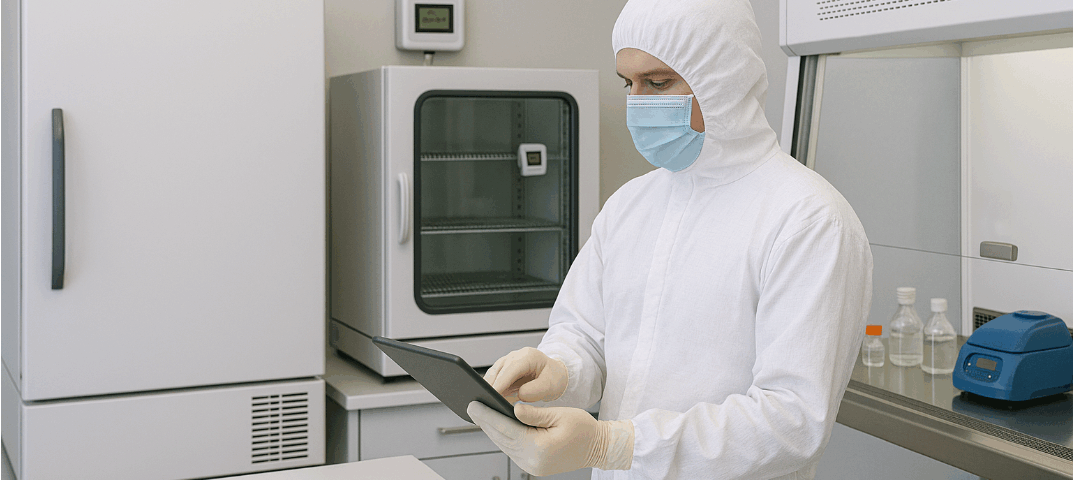
Running a research lab is about more than brilliant minds and precise experiments. The foundation of every breakthrough depends on an environment that is safe, stable, and compliant. A single environmental slip can undo years of effort. When a freezer fails overnight, when humidity creeps up in a clean room, or when an incubator drifts out of range, the damage is not just about equipment. It is about data that can no longer be trusted, samples that cannot be replaced, and funding that may be lost.
Many labs believe they are protected because they monitor their freezers or refrigerators. The reality is that other zones in the lab are just as critical. If those areas go unchecked, blind spots appear that put research at risk.
At TempGenius, we have seen how a comprehensive monitoring strategy shifts a lab from reacting to emergencies to preventing them. By extending oversight across the full environment, research teams gain confidence that their work is safe and their results are reliable.
Here are five critical lab zones that deserve consistent monitoring, along with a checklist you can use to see if your lab is fully covered:
Ultra-low freezers and laboratory refrigerators are the lifeline of most research facilities. They protect biological samples, reagents, vaccines, and other materials that often represent years of work and significant investment. The margin for error is incredibly small. Even a slight drift of just a couple of degrees can be enough to compromise the integrity of what is inside. Once that happens, the damage cannot be undone, and the loss is more than financial. It can set back an entire project, delay publications, and even impact future funding.
The risks are greater than many realize. Equipment does not always fail in dramatic fashion. Sometimes the problem is as simple as a door left open for too long or a power outage that happens after everyone has gone home. Without the right monitoring in place, these events can go unnoticed until it is too late.
Protecting these critical assets requires more than a daily check or a quick glance at the display. Continuous temperature monitoring in real time ensures that any fluctuation is detected the moment it happens. Automated alerts can notify staff immediately when temperatures drift outside preset thresholds, giving them the chance to act before damage occurs. Just as important, automatic backup logging creates a reliable record for compliance and audits. Together, these safeguards provide peace of mind that what is stored today will still be viable tomorrow.
Incubators and growth chambers are the heart of many biological experiments. They provide the carefully controlled environments where cell cultures, bacterial colonies, and other sensitive biological processes take shape. Stability in temperature and humidity is not a luxury here, it is the baseline requirement for results that can be trusted. A small shift in conditions can change growth rates, alter behavior, or even kill the cultures that a project depends on.
The risks of variability are often underestimated. A single unstable incubator can force researchers to repeat weeks or months of work, driving up costs and delaying discoveries. Worse yet, inconsistency in these environments can create results that look valid on the surface but are not truly reproducible. When that happens, the credibility of the work is at stake.
To protect against these risks, labs need more than a simple thermostat readout. Dual monitoring of both temperature and humidity provides the full picture of the environment inside. For cell culture incubators, CO₂ levels must also be tracked to maintain the conditions required for proper growth. Beyond real-time monitoring, historical reports are essential. They allow researchers to demonstrate that conditions were consistent throughout an experiment and give them the ability to identify and correct issues before they turn into setbacks. This combination of real-time oversight and historical accountability makes monitoring incubators and growth chambers an investment in both reliability and reputation.
Clean rooms and controlled environments are some of the most sensitive spaces in research. In pharmaceutical, biotech, and nanotech labs, even the smallest particle or fluctuation can derail production and compromise safety. These rooms are designed to keep contamination out and maintain precise conditions, but without continuous monitoring, problems can slip in quietly and go unnoticed until they have already caused damage.
The stakes in these environments are incredibly high. A lapse in sterility can ruin entire batches of product, forcing costly recalls or shutdowns. Experiments can be compromised by conditions that fall just outside the acceptable range, even if no one notices in the moment. On top of that, regulatory standards are strict, and violations can lead to fines, failed audits, and long-term reputational harm.
To protect clean rooms, it is not enough to rely on manual checks or occasional inspections. Continuous monitoring of temperature, humidity, and differential pressure is essential to confirm that the environment is stable. Particulate monitoring helps ensure compliance with ISO standards, providing confidence that the room is operating at the required level of cleanliness. Just as important is a clear system of alert escalation, so that when conditions drift out of specification, the right people are notified immediately and corrective action can begin without delay. By treating clean rooms as dynamic environments that require constant oversight, labs can safeguard both their work and their compliance obligations.
Animal rooms and vivariums present a unique challenge in research facilities because they are living environments as well as experimental spaces. The welfare of the animals directly affects the quality and validity of the data produced. When animals are stressed by their environment, their biological responses can shift in ways that make results unreliable. What looks like a meaningful change in an experiment may actually be the consequence of a poorly regulated room. Stability in temperature, humidity, ventilation, and light cycles is not only about animal comfort, it is a requirement for trustworthy science.
The risks in these spaces are significant. Heat spikes can quickly create dangerous conditions, especially for species that are sensitive to temperature. Ventilation problems can cause a buildup of harmful gases or disrupt air flow in ways that impact both health and behavior. Even subtle, undetected changes in light cycles can alter circadian rhythms, which in turn influence everything from hormone levels to activity patterns. Left unchecked, these environmental shifts can invalidate entire studies.
Protecting animal rooms and vivariums requires monitoring across multiple dimensions. Temperature and humidity should be tracked in different zones to ensure consistency throughout the room, not just at a single point. Automated light cycle logging helps confirm that day and night conditions remain stable over time. Just as important, alerting systems must meet the standards set by IACUC and AAALAC, ensuring compliance while also providing staff with the ability to respond quickly when something goes wrong. By keeping these environments stable, research teams protect both the welfare of the animals and the integrity of the data that comes from their work.
Not every critical asset in a research facility sits inside a freezer or incubator. Storage rooms and general lab spaces often hold reagents, instruments, and sensitive documentation that are just as vital to the success of ongoing projects. These areas may seem less vulnerable because they operate at ambient conditions, but that perception can create blind spots. The truth is that small environmental changes in these spaces can have a major impact on both research continuity and long-term facility health.
The risks are varied and often hidden. Humidity that creeps too high can damage paper records, corrode instruments, and degrade reagents. HVAC fluctuations can alter the stability of materials that are meant to be stored at consistent room temperature. Water leaks, whether from plumbing issues or building infrastructure, often go unnoticed until damage is widespread and costly to repair. Without proper oversight, these quiet threats can escalate into serious disruptions.
Continuous monitoring of temperature and relative humidity in these rooms ensures that ambient conditions remain within safe ranges. Leak detection sensors provide early warning before small water issues turn into major losses. Integrating monitoring systems with the building’s management infrastructure gives facility managers a complete view of environmental performance, making it easier to spot trends and prevent problems before they escalate. By extending attention beyond the obvious high-risk equipment, labs can strengthen resilience and protect the assets that support daily operations.
Protecting the mission of a research facility requires looking beyond a single piece of equipment. Freezers and refrigerators are critical, but they are only one part of the larger environment that supports reliable science. Clean rooms, incubators, animal spaces, and even general storage areas all play a role in whether research can stand up to scrutiny and move projects forward without disruption. When one zone fails, the entire chain of integrity is weakened.
That is why a whole-lab approach to monitoring is essential. By tracking conditions across all five zones, labs move from patchwork oversight to a system of complete protection. This is not just about avoiding emergencies, it is about building confidence in every step of the research process. TempGenius makes that possible by providing seamless monitoring, real-time alerts, and automated reporting that work together to safeguard both science and compliance.
The question every lab should ask is simple: are you monitoring all of these zones? If the answer is no, then there is an opportunity to strengthen your strategy and protect the investment of time, talent, and funding that research demands. In science, prevention is always less costly than recovery. With the right tools in place, you can focus on discovery knowing that the environment around your work is secure.
For more information on how TempGenius can transform your temperature management systems and help you achieve regulatory compliance, please contact us today. Stay tuned to our blog for more insights on technology, compliance, and the future of temperature management.
Contact us to customize a Temperature Monitoring Solution for your enterprise.
Give us a call or email us and let’s discuss the most appropriate temperature monitoring sensor for your company.